
Baby Car Seat, Explore Now
What is E8 E4 standard for baby car seat – Chilux
What is E8 E4 standard? E8 is certified by the Czech Republic and when the baby car seat is tested and certified in the Netherlands, it will have the E4 label.
Car seats for children are stamped with an E-certified orange, proving that the product has passed safety tests conducted by a member country in the ECE stands for Economic Commission for Europe.
Above is some basic information, to be able to understand clearly what are the European safety car seat standards for children E8, E4? Then let’s find out more details with Chilux.
Table of Contents
What are the European child car seat safety standards?
The European child car seat safety standard is regulated and promulgated by the ECE. If car seat products pass the ECE tests, they can be sold and used in ECE member countries and registered countries that comply with ECE regulations.
Up to now, through research, testing, etc., there are two sets of European car seat safety standards issued, ECE R44 and ECE i-Size.
ECE R44 was approved on November 17, 1982, in Europe, after a series of child car seat safety tests. This regulation is in force in most European territories, as well as member states. To date, the ECE R44 standard has undergone four revisions to meet practical safety requirements.
Thus, the last two digits of the ECE regulation R44/04 that we still see on the orange baby car seat labels, indicate that the product has been approved under the fourth version of the regulation, entered into force in June 2005
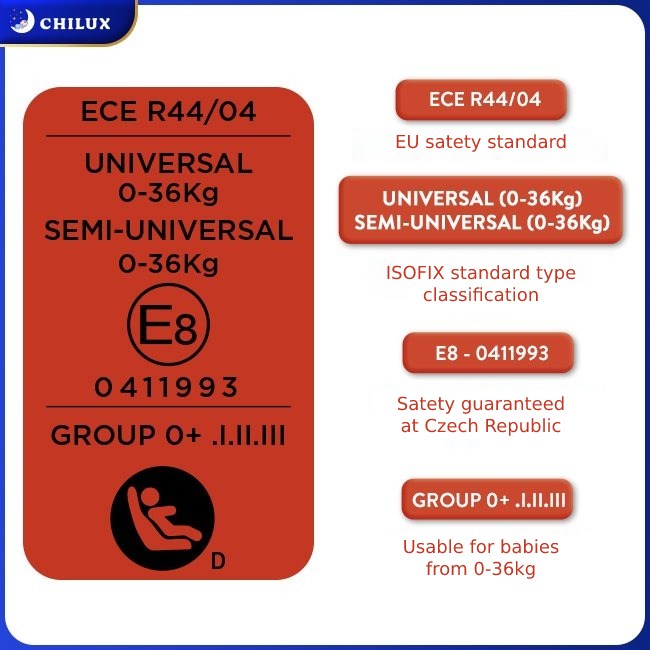
And this is also the latest version of Regulation No. 44 on safety standards for baby car seats issued by the European Economic Commission. Up to now, this version is still valid.
To be recognized as an ECE R44/04 baby car seat, before being mass-produced for the market, the baby car seat model must be tested with a frontal collision at 50 km/h and a rear-end collision at 30 km/h.
With the help of baby dummies and specialized measuring devices, experts can know how well a baby car seat is. If the safety standards are not met in the tests, the model must be redesigned and not allowed to be mass produced.
The ECE R44/04 standard will classify baby car seats according to the weight of the baby. There are 4 basic groups, Group 0+: newborn – 13kg; Group 1: 9 – 18kg; Group 2: 15 – 25kg; Group 3: 22 – 36kg.
This standard also clearly requires that baby car seats used for children in group 0+ must face back; Children from group 1 can face forward, but experts recommend a rearward facing position for babies in group 1.
ISOFIX and Seat Belt are two ways to install baby car seats on car seats according to ECE R44/04 standard. In particular, ISOFIX allows simple operation but ensures accuracy, and is recommended to become popular.
What is the European safety child car seat standard E8, E4?
ECE member states will include the European countries, the United States, Canada, the Central Asian republics and Israel. ECE R44/04 is issued by the European Economic Commission and recommended by member states but not mandatory. This means that member countries can fully apply the provisions of ECE R44/04 but can also have their own regulations.
And to distinguish baby car seats that have been tested and evaluated for safety standards in which member countries of the ECE, the E-mark label was born. E-mark labels are denoted very simply by a capital letter E, after this letter there will be a number. This number represents the country in which the audit was performed.
Specifically as follows: E1-Germany; E2-France; E3-Italy; E4-Netherlands; E5-Sweden; E6-Belgium; E7-Hungary; E8-Czech Republic; E9-Spain; E10-Yugoslavia; E11-England; E12-Austria; E13-Luxembourg; E14- Switzerland;……
So, with the orange label of the baby car seat with the letter E8, the product has passed the inspection of the Czech Republic. And E4 proves that the car seat has passed the tests in the Netherlands.
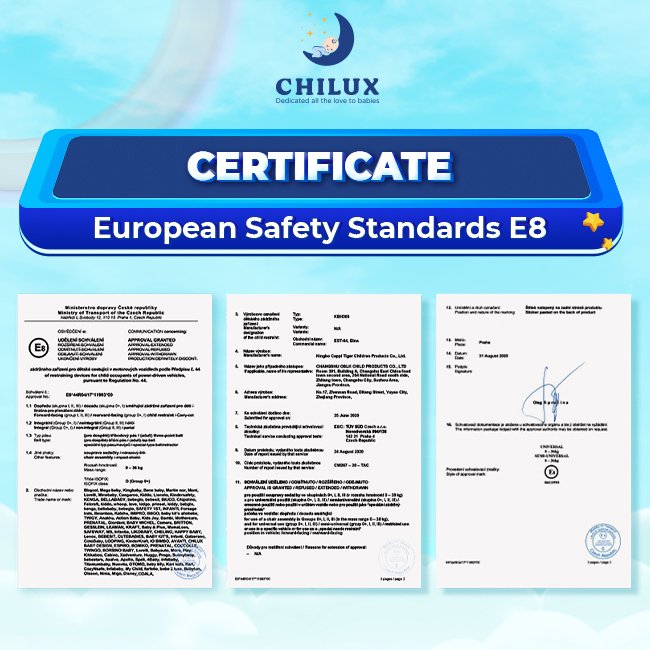
However, it should always be noted that a baby car seat with a capital E label indicates that it has been tested by an ECE country. But if a product is related to technical vehicles, motor vehicles and receives a lowercase e label, it proves to have passed the tests of a member state within the EU only (European Union).
Where should I check the European E8, E4 label for baby car seats?
Aim for users to easily check that the baby car seat that they are going to buy receives a safety certificate according to which European safety standard? Which country in the ECE conducts the test? How much is that child seat? Install ISOFIX or Seat Belt?…. Each baby car seat will have an orange label.
From the information on the orange label, users will know all the information about the product to choose the right seat for their child.
Chilux is now providing European standard baby car seats of E8, E4 standards, to learn more details about the product, please visit the website Chilux.sg or contact Hotline: +84388 922 442 for immediate support.
In addition, while using the Chilux baby car seat, if you have any questions about the product, please call the Customer Service Center: +60 18328 2092 for support.


Бонусные предложения казино рассчитаны
как на новых, так и на постоянных игроков, что гарантирует, что все игроки имеют возможность воспользоваться щедростью платформы.
Allergic rhinitis understanding
I am sure this piece of writing has touched all the internet visitors, its really really nice piece of writing on building up
new blog.
My page เว็บวาไรตี้
This city is developing the world’s tallest timber tower, again
[url=https://jobgirl24.ru/ ]работа для девушек досуг[/url]
The US city of Milwaukee is already home to the world’s tallest timber tower. But another, even taller, wooden skyscraper could be added to its skyline, designed by Vancouver-based studio Michael Green Architects (MGA).
The firm recently released plans for the development, which includes a 55-story tower made principally from mass timber — thick, compressed, multilayered panels of solid wood. If built, it would usurp the current world title holder, the 25-story Ascent tower by Korb + Associates Architects, as well as becoming the tallest building in the state of Wisconsin.
MGA, which specializes in wooden architecture, hopes that the project will set a “new global benchmark for mass timber construction.”
The project is part of the redevelopment of the Marcus Performing Arts Center, which opened in 1969 and won the Honor Award for Excellence in Architectural Design from the American Institute of Architects in 1970. Led by Neutral, which bills itself as a “regenerative development company,” the redesign will transform what is currently the center’s concrete parking lot into a space with residential units, offices, restaurants, cafes, grocery stores and public plazas. According to MGA, construction will cost an estimated $700 million. The plan is currently going through the city’s approval process, during which it is expected to evolve.
Why timber?
While the use of mass timber is steadily increasing worldwide, thanks to changes in building regulations and shifting attitudes towards the material, it has yet to match the sheer height of buildings made of concrete and steel — although a slew of timber high-rises have been proposed in recent years. MGA says its tower design would be approximately 600 feet (182 meters) tall — more than double the 284 feet (87 meter) tall Ascent tower.
“The race for height is important,” said Michael Green, an architect and founder of MGA. “It’s not about showing off, it’s about showing what’s possible to the public.”
He argued that the reason timber skyscrapers haven’t yet become mainstream is because climate change hasn’t been at the center of the conversation. “We didn’t really need to challenge the status quo of steel and concrete,” he said. “But because those materials are so hard on the climate, we had to find a different way to build towers and big buildings in general.”
Experience exceptional Buffalo to Toronto limo service with our luxury and executive options. Whether you need a ride from Buffalo to Toronto Pearson or a private car service, enjoy a smooth and sophisticated journey across the border.