
Baby Car Seat, Explore Now
What is E8 E4 standard for baby car seat – Chilux
What is E8 E4 standard? E8 is certified by the Czech Republic and when the baby car seat is tested and certified in the Netherlands, it will have the E4 label.
Car seats for children are stamped with an E-certified orange, proving that the product has passed safety tests conducted by a member country in the ECE stands for Economic Commission for Europe.
Above is some basic information, to be able to understand clearly what are the European safety car seat standards for children E8, E4? Then let’s find out more details with Chilux.
Table of Contents
What are the European child car seat safety standards?
The European child car seat safety standard is regulated and promulgated by the ECE. If car seat products pass the ECE tests, they can be sold and used in ECE member countries and registered countries that comply with ECE regulations.
Up to now, through research, testing, etc., there are two sets of European car seat safety standards issued, ECE R44 and ECE i-Size.
ECE R44 was approved on November 17, 1982, in Europe, after a series of child car seat safety tests. This regulation is in force in most European territories, as well as member states. To date, the ECE R44 standard has undergone four revisions to meet practical safety requirements.
Thus, the last two digits of the ECE regulation R44/04 that we still see on the orange baby car seat labels, indicate that the product has been approved under the fourth version of the regulation, entered into force in June 2005
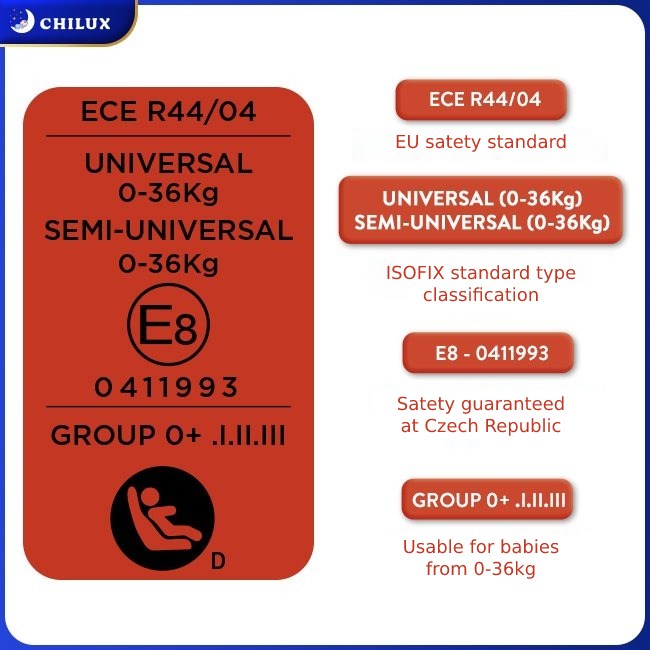
And this is also the latest version of Regulation No. 44 on safety standards for baby car seats issued by the European Economic Commission. Up to now, this version is still valid.
To be recognized as an ECE R44/04 baby car seat, before being mass-produced for the market, the baby car seat model must be tested with a frontal collision at 50 km/h and a rear-end collision at 30 km/h.
With the help of baby dummies and specialized measuring devices, experts can know how well a baby car seat is. If the safety standards are not met in the tests, the model must be redesigned and not allowed to be mass produced.
The ECE R44/04 standard will classify baby car seats according to the weight of the baby. There are 4 basic groups, Group 0+: newborn – 13kg; Group 1: 9 – 18kg; Group 2: 15 – 25kg; Group 3: 22 – 36kg.
This standard also clearly requires that baby car seats used for children in group 0+ must face back; Children from group 1 can face forward, but experts recommend a rearward facing position for babies in group 1.
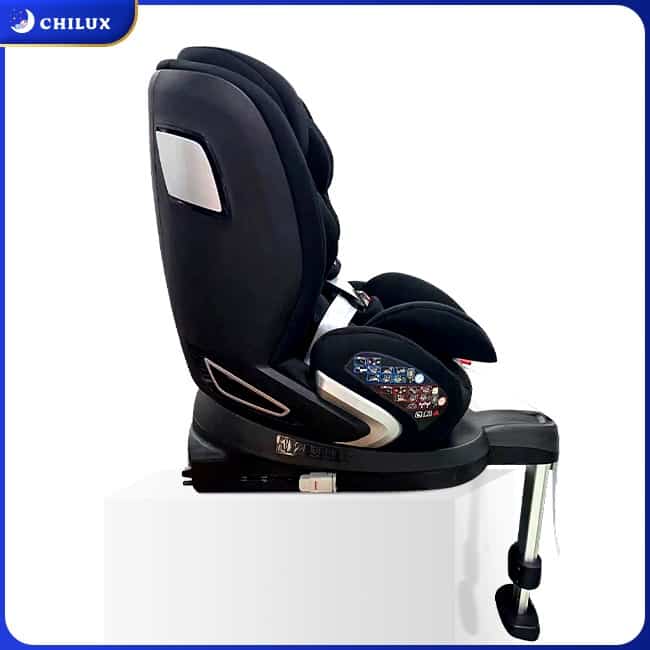
ISOFIX and Seat Belt are two ways to install baby car seats on car seats according to ECE R44/04 standard. In particular, ISOFIX allows simple operation but ensures accuracy, and is recommended to become popular.
What is the European safety child car seat standard E8, E4?
ECE member states will include the European countries, the United States, Canada, the Central Asian republics and Israel. ECE R44/04 is issued by the European Economic Commission and recommended by member states but not mandatory. This means that member countries can fully apply the provisions of ECE R44/04 but can also have their own regulations.
And to distinguish baby car seats that have been tested and evaluated for safety standards in which member countries of the ECE, the E-mark label was born. E-mark labels are denoted very simply by a capital letter E, after this letter there will be a number. This number represents the country in which the audit was performed.
Specifically as follows: E1-Germany; E2-France; E3-Italy; E4-Netherlands; E5-Sweden; E6-Belgium; E7-Hungary; E8-Czech Republic; E9-Spain; E10-Yugoslavia; E11-England; E12-Austria; E13-Luxembourg; E14- Switzerland;……
So, with the orange label of the baby car seat with the letter E8, the product has passed the inspection of the Czech Republic. And E4 proves that the car seat has passed the tests in the Netherlands.
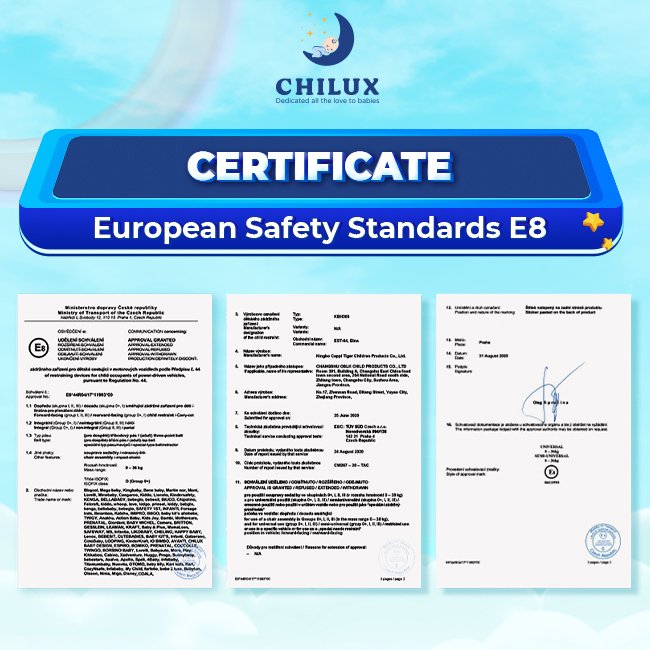
However, it should always be noted that a baby car seat with a capital E label indicates that it has been tested by an ECE country. But if a product is related to technical vehicles, motor vehicles and receives a lowercase e label, it proves to have passed the tests of a member state within the EU only (European Union).
Where should I check the European E8, E4 label for baby car seats?
Aim for users to easily check that the baby car seat that they are going to buy receives a safety certificate according to which European safety standard? Which country in the ECE conducts the test? How much is that child seat? Install ISOFIX or Seat Belt?…. Each baby car seat will have an orange label.
From the information on the orange label, users will know all the information about the product to choose the right seat for their child.
Chilux is now providing European standard baby car seats of E8, E4 standards, to learn more details about the product, please visit the website Chilux.sg or contact Hotline: +84388 922 442 for immediate support.
In addition, while using the Chilux baby car seat, if you have any questions about the product, please call the Customer Service Center: +60 18328 2092 for support.


Get low price of tadalafil 6mg vs 9mg will have an impact on your budget so shop online.
Meds information. Drug Class.
where to get dramamine no prescription
All about medicament. Get here.
doxycycline antibiotic for chlamydia
What the rising popularity of Yemeni coffee shops says about third places
[url=https://kr13at.cc]kraken shop[/url]
The most popular spot on a late Friday night in a pocket of Manhattan’s West Village isn’t a trendy bar or a Michelin-starred restaurant but a Yemeni coffee house chain strictly serving coffee, tea and pastries.
A step into Qahwah House on Carmine Street offers a rich whiff of cardamom, Arabic music and crowds of people both at tables and in line to order. The energy spills over into the sidewalk, where some begin performing a Levantine folk dance known as dabke. It’s a snapshot of various Eastern cultures; Arabic, Farsi and Urdu fill the air, and some customers don traditional attire.
https://kr13at.cc
kraken darknet
Qahwah House is just one of a string of Yemeni coffee chains that originated in the Arab-populated Detroit area and are rapidly springing up across the country, often where there are significant Middle Eastern and Muslim populations. Nineteen Qahwah House locations are open across seven states, with more under construction and expected to open this year. Another chain, Haraz, opened this month in the pricey SoHo neighborhood in Manhattan, with at least six more in the region planned in the next two years. Times Square will be home to two other chains, MOKAFE and Qamaria Yemeni Coffee Co.
The rapid expansion of these shops underscores the demand for late-night social spots for not only young Muslims and Middle Easterners, but also younger people who are looking for a non-digital third space where they can hang out without alcohol or having to yell over loud music.
They don’t have many other options. Malls, a traditional third place for young people, are growing more and more unpopular. Chains like Starbucks have become more like take-out counters. Alcohol-free lifestyles are growing even for those outside of the Muslim faith, which many practicing the religion already take part in.
So for many young people in urban areas, especially those from immigrant communities looking for a way to connect to their cultures, it’s a great option.
Stake.com is a well-known betting site famous for its cryptocurrency-enabled deposits and withdrawals.
Users love Stake due to its efficient transaction speeds,
wide variety of games, and custom rewards that keep them playing.
With a user-friendly layout, both beginners and pros alike can enjoy the diverse functions Stake offers.
Ranging from sports events to real-time casino play, it offers diverse
options for all players. Moreover, Stake’s dedicated help desk guarantees problems are
handled fast.
All in all, Stake’s platform offers a smooth crypto gaming enthusiasts seeking thrilling plus great benefits!