
Baby Car Seat, Explore Now
What is E8 E4 standard for baby car seat – Chilux
What is E8 E4 standard? E8 is certified by the Czech Republic and when the baby car seat is tested and certified in the Netherlands, it will have the E4 label.
Car seats for children are stamped with an E-certified orange, proving that the product has passed safety tests conducted by a member country in the ECE stands for Economic Commission for Europe.
Above is some basic information, to be able to understand clearly what are the European safety car seat standards for children E8, E4? Then let’s find out more details with Chilux.
Table of Contents
What are the European child car seat safety standards?
The European child car seat safety standard is regulated and promulgated by the ECE. If car seat products pass the ECE tests, they can be sold and used in ECE member countries and registered countries that comply with ECE regulations.
Up to now, through research, testing, etc., there are two sets of European car seat safety standards issued, ECE R44 and ECE i-Size.
ECE R44 was approved on November 17, 1982, in Europe, after a series of child car seat safety tests. This regulation is in force in most European territories, as well as member states. To date, the ECE R44 standard has undergone four revisions to meet practical safety requirements.
Thus, the last two digits of the ECE regulation R44/04 that we still see on the orange baby car seat labels, indicate that the product has been approved under the fourth version of the regulation, entered into force in June 2005
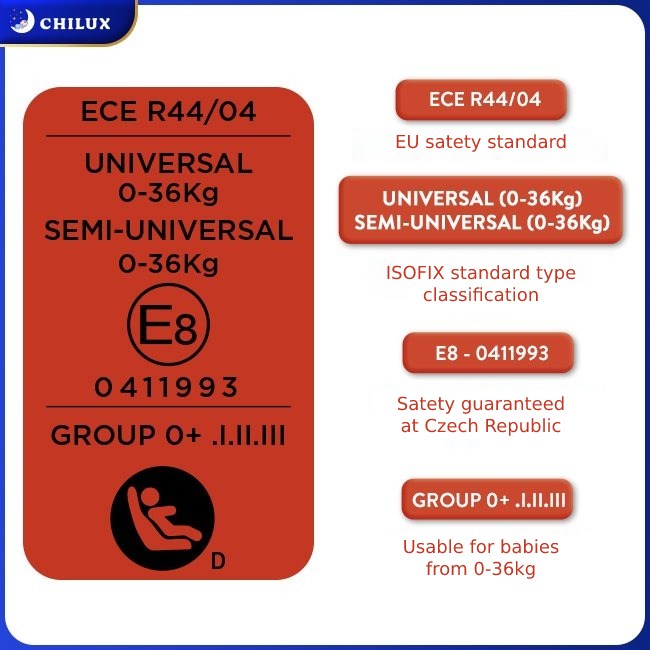
And this is also the latest version of Regulation No. 44 on safety standards for baby car seats issued by the European Economic Commission. Up to now, this version is still valid.
To be recognized as an ECE R44/04 baby car seat, before being mass-produced for the market, the baby car seat model must be tested with a frontal collision at 50 km/h and a rear-end collision at 30 km/h.
With the help of baby dummies and specialized measuring devices, experts can know how well a baby car seat is. If the safety standards are not met in the tests, the model must be redesigned and not allowed to be mass produced.
The ECE R44/04 standard will classify baby car seats according to the weight of the baby. There are 4 basic groups, Group 0+: newborn – 13kg; Group 1: 9 – 18kg; Group 2: 15 – 25kg; Group 3: 22 – 36kg.
This standard also clearly requires that baby car seats used for children in group 0+ must face back; Children from group 1 can face forward, but experts recommend a rearward facing position for babies in group 1.
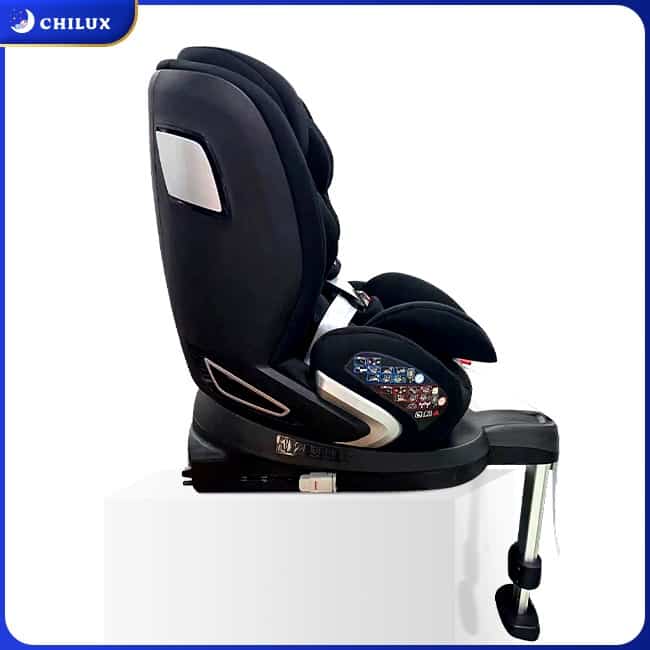
ISOFIX and Seat Belt are two ways to install baby car seats on car seats according to ECE R44/04 standard. In particular, ISOFIX allows simple operation but ensures accuracy, and is recommended to become popular.
What is the European safety child car seat standard E8, E4?
ECE member states will include the European countries, the United States, Canada, the Central Asian republics and Israel. ECE R44/04 is issued by the European Economic Commission and recommended by member states but not mandatory. This means that member countries can fully apply the provisions of ECE R44/04 but can also have their own regulations.
And to distinguish baby car seats that have been tested and evaluated for safety standards in which member countries of the ECE, the E-mark label was born. E-mark labels are denoted very simply by a capital letter E, after this letter there will be a number. This number represents the country in which the audit was performed.
Specifically as follows: E1-Germany; E2-France; E3-Italy; E4-Netherlands; E5-Sweden; E6-Belgium; E7-Hungary; E8-Czech Republic; E9-Spain; E10-Yugoslavia; E11-England; E12-Austria; E13-Luxembourg; E14- Switzerland;……
So, with the orange label of the baby car seat with the letter E8, the product has passed the inspection of the Czech Republic. And E4 proves that the car seat has passed the tests in the Netherlands.
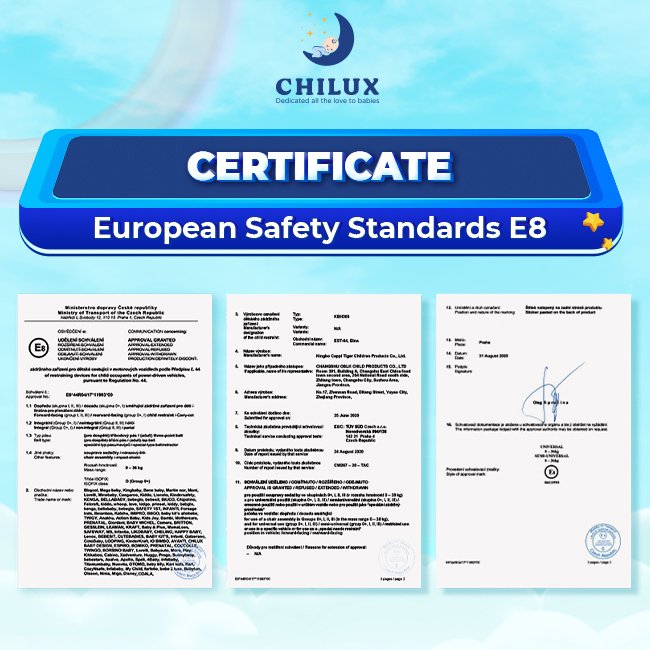
However, it should always be noted that a baby car seat with a capital E label indicates that it has been tested by an ECE country. But if a product is related to technical vehicles, motor vehicles and receives a lowercase e label, it proves to have passed the tests of a member state within the EU only (European Union).
Where should I check the European E8, E4 label for baby car seats?
Aim for users to easily check that the baby car seat that they are going to buy receives a safety certificate according to which European safety standard? Which country in the ECE conducts the test? How much is that child seat? Install ISOFIX or Seat Belt?…. Each baby car seat will have an orange label.
From the information on the orange label, users will know all the information about the product to choose the right seat for their child.
Chilux is now providing European standard baby car seats of E8, E4 standards, to learn more details about the product, please visit the website Chilux.sg or contact Hotline: +84388 922 442 for immediate support.
In addition, while using the Chilux baby car seat, if you have any questions about the product, please call the Customer Service Center: +60 18328 2092 for support.


Exceptional prices allow you to buy viagra cialis levitra online guarantee top performance?
Hi, i read your blog from time to time and i own a
similar one and i was just wondering if you get a lot of spam feedback?
If so how do you stop it, any plugin or anything you can advise?
I get so much lately it’s driving me insane so any support is very much appreciated.
Feel free to surf to my web site A片
Scientists say skeletal remains found in castle well belong to figure from 800-year-old saga
[url=https://kra16f.cc]kraken войти[/url]
Researchers have connected the identity of skeletal remains found in a well at Norway’s Sverresborg castle to a passage in a centuries-old Norse text.
The 800-year-old Sverris saga, which follows the story of the real-life King Sverre Sigurdsson, includes the tossing of the body of a dead man — later known as “Well-man” — down a well during a military raid in central Norway in 1197.
https://kra16f.cc
kraken войти
It’s likely, according to the text, that raiders lobbed the body into the well to poison the main water source for locals, but little else is said about the man or who he was in the saga.
Researchers initially uncovered the bones in the castle’s well in 1938, but they were only able to carry out a visual analysis at the time. Now, scientists have an array of analytical techniques at their disposal, including genetic sequencing and radiocarbon dating.
A new study on the remains, published Friday in the Cell Press journal iScience, reveals unprecedented insights into Well-man’s appearance based on in-depth research on samples of his teeth.
“This is the first time that a person described in these historical texts has actually been found,” said study coauthor Michael D. Martin, a professor in the department of natural history at the Norwegian University of Science and Technology’s University Museum in Trondheim, in a statement.
“There are a lot of these medieval and ancient remains all around Europe, and they’re increasingly being studied using genomic methods.”
The findings not only shed fresh light on what Well-man looked like but also who he was, with a surprising twist about how he ended up in a Norse saga.
Way cool! Some extremely valid points! I appreciate you penning this
article and also the rest of the site is also really good.
This teen became the youngest person to summit the world’s highest peaks. Now he wants others to follow in his footsteps
[url=https://kra16f.cc]kraken[/url]
Nima Rinji Sherpa’s ears are still tinged black from wind chill, an occupational hazard of climbing to heights where humans struggle to breathe, and where the weather can turn deadly in an instant.
This month, Nima became the youngest person to summit all 14 of the world’s highest peaks, but the 18-year-old Nepalese mountaineer is already getting ready for his next big feat.
https://kra16f.cc
Площадка кракен
Speaking to CNN via video call from the Nepali capital Kathmandu last week, Nima said he’s taking a couple weeks’ rest before preparing to climb the world’s eighth-highest mountain, Manaslu, with Italian mountaineer Simone Moro – in winter, alpine-style.
“That means we’re climbing an 8,000-meter mountain in winter… There’s no fixed ropes for us, there’s no (supplemental) oxygen for us, there is no support for us. So, it’s like pure human endurance,” Nima said. “It has never been done in the history of mountaineering.”
After that, “I’ll take some rest,” Nima laughed.
On October 9, Nima reached the top of the 8,027-meter (26,335-foot) Shishapangma along with his partner Pasang Nurbu Sherpa. For Nima, it was the final of the “eight-thousanders,” the 14 peaks recognized by the International Climbing and Mountaineering Federation as standing more than 8,000 meters above sea level.
Describing the moment of summiting the final peak as “pure joy,” Nima said his motivation comes from his family, many of whom are renowned mountaineers.
His father, Tashi Lakpa Sherpa, has climbed Everest nine times, and at age 19 became the youngest person to summit without bottled oxygen. His uncle Mingma Sherpa became the first South Asian climber to summit the 14 peaks in 2011.
“My uncles and my father, they are way more successful than I would ever be because they came from a very small village. To even dream about being this successful, for them it was really hard,” Nima said. “I have the privilege that they didn’t have.”