
Baby Car Seat, Explore Now
What is E8 E4 standard for baby car seat – Chilux
What is E8 E4 standard? E8 is certified by the Czech Republic and when the baby car seat is tested and certified in the Netherlands, it will have the E4 label.
Car seats for children are stamped with an E-certified orange, proving that the product has passed safety tests conducted by a member country in the ECE stands for Economic Commission for Europe.
Above is some basic information, to be able to understand clearly what are the European safety car seat standards for children E8, E4? Then let’s find out more details with Chilux.
Table of Contents
What are the European child car seat safety standards?
The European child car seat safety standard is regulated and promulgated by the ECE. If car seat products pass the ECE tests, they can be sold and used in ECE member countries and registered countries that comply with ECE regulations.
Up to now, through research, testing, etc., there are two sets of European car seat safety standards issued, ECE R44 and ECE i-Size.
ECE R44 was approved on November 17, 1982, in Europe, after a series of child car seat safety tests. This regulation is in force in most European territories, as well as member states. To date, the ECE R44 standard has undergone four revisions to meet practical safety requirements.
Thus, the last two digits of the ECE regulation R44/04 that we still see on the orange baby car seat labels, indicate that the product has been approved under the fourth version of the regulation, entered into force in June 2005
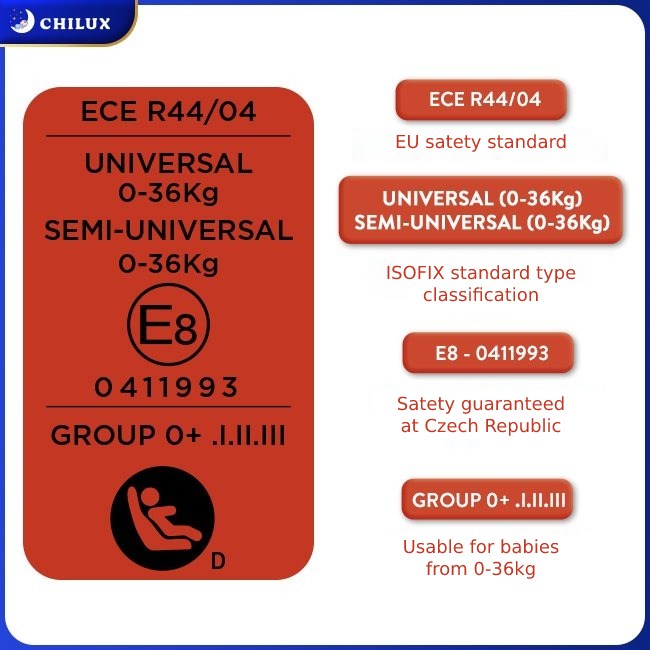
And this is also the latest version of Regulation No. 44 on safety standards for baby car seats issued by the European Economic Commission. Up to now, this version is still valid.
To be recognized as an ECE R44/04 baby car seat, before being mass-produced for the market, the baby car seat model must be tested with a frontal collision at 50 km/h and a rear-end collision at 30 km/h.
With the help of baby dummies and specialized measuring devices, experts can know how well a baby car seat is. If the safety standards are not met in the tests, the model must be redesigned and not allowed to be mass produced.
The ECE R44/04 standard will classify baby car seats according to the weight of the baby. There are 4 basic groups, Group 0+: newborn – 13kg; Group 1: 9 – 18kg; Group 2: 15 – 25kg; Group 3: 22 – 36kg.
This standard also clearly requires that baby car seats used for children in group 0+ must face back; Children from group 1 can face forward, but experts recommend a rearward facing position for babies in group 1.
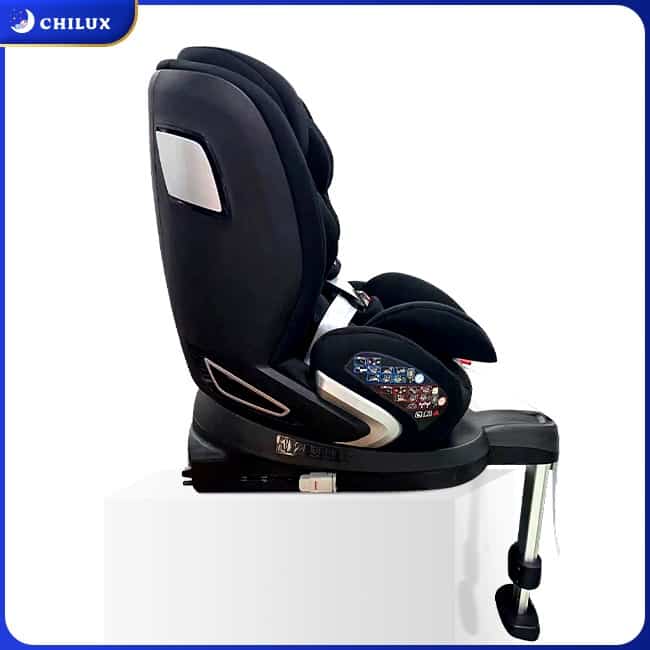
ISOFIX and Seat Belt are two ways to install baby car seats on car seats according to ECE R44/04 standard. In particular, ISOFIX allows simple operation but ensures accuracy, and is recommended to become popular.
What is the European safety child car seat standard E8, E4?
ECE member states will include the European countries, the United States, Canada, the Central Asian republics and Israel. ECE R44/04 is issued by the European Economic Commission and recommended by member states but not mandatory. This means that member countries can fully apply the provisions of ECE R44/04 but can also have their own regulations.
And to distinguish baby car seats that have been tested and evaluated for safety standards in which member countries of the ECE, the E-mark label was born. E-mark labels are denoted very simply by a capital letter E, after this letter there will be a number. This number represents the country in which the audit was performed.
Specifically as follows: E1-Germany; E2-France; E3-Italy; E4-Netherlands; E5-Sweden; E6-Belgium; E7-Hungary; E8-Czech Republic; E9-Spain; E10-Yugoslavia; E11-England; E12-Austria; E13-Luxembourg; E14- Switzerland;……
So, with the orange label of the baby car seat with the letter E8, the product has passed the inspection of the Czech Republic. And E4 proves that the car seat has passed the tests in the Netherlands.
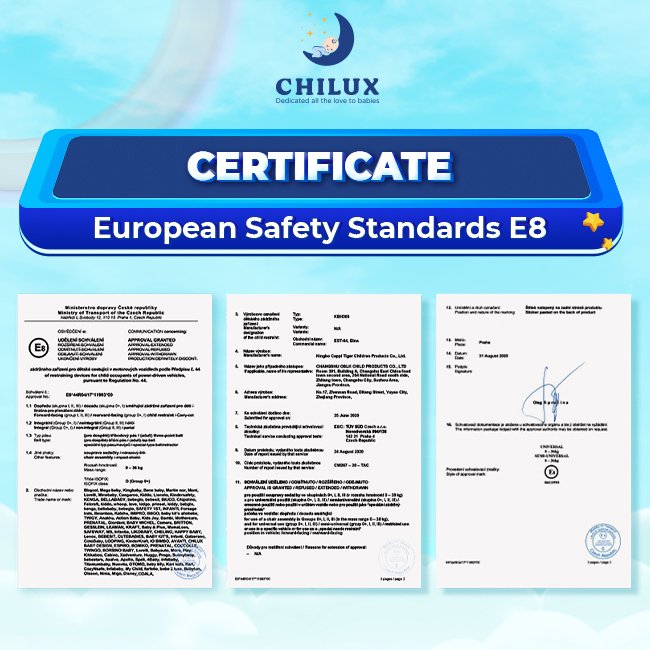
However, it should always be noted that a baby car seat with a capital E label indicates that it has been tested by an ECE country. But if a product is related to technical vehicles, motor vehicles and receives a lowercase e label, it proves to have passed the tests of a member state within the EU only (European Union).
Where should I check the European E8, E4 label for baby car seats?
Aim for users to easily check that the baby car seat that they are going to buy receives a safety certificate according to which European safety standard? Which country in the ECE conducts the test? How much is that child seat? Install ISOFIX or Seat Belt?…. Each baby car seat will have an orange label.
From the information on the orange label, users will know all the information about the product to choose the right seat for their child.
Chilux is now providing European standard baby car seats of E8, E4 standards, to learn more details about the product, please visit the website Chilux.sg or contact Hotline: +84388 922 442 for immediate support.
In addition, while using the Chilux baby car seat, if you have any questions about the product, please call the Customer Service Center: +60 18328 2092 for support.


Bitcoin news updates
In the ever-changing landscape of digital currencies, staying informed is crucial.
New occurrences can shape the market in unexpected ways. Enthusiasts and investors alike are eager to grasp the latest
trends. Every day brings fresh possibilities and potential risks; this is what makes it so exciting.
The realm of virtual assets evolves rapidly, and understanding the nuances
keeps stakeholders engaged. From regulatory changes to technological breakthroughs,
there is always something worthwhile to explore. Prices fluctuate constantly, driven by a myriad of factors, from market sentiment to innovation. It’s a thrilling time to witness how various elements interplay in this dynamic environment.
Recent advancements have sparked heated discussions among
experts and beginners. Many are anxious to analyze the implications
of these shifts on their strategies and investments. Staying
up-to-date with these developments is essential for making informed decisions.
As we dive deeper into these fluctuations, let’s ensure that
we remain vigilant and adaptable in this rapidly changing domain.
Emerging Trends in Bitcoin Market
In the ever-evolving landscape of digital currencies,
several new patterns are starting to emerge. The market is buzzing with innovation and shifting dynamics.
More and more individuals are becoming interested in decentralized finance
and the opportunities it presents. Additionally, there’s a noticeable surge in institutional involvement.
This growing interest among large entities indicates a shift in perception.
It’s no longer seen as just a speculative asset. Rather, it’s gaining credibility as
a legitimate store of value. Furthermore, technological advancements are creating greater
accessibility for everyday users.
For example, developments in wallet security and transaction efficiency are crucial.
As these factors improve, more general consumers feel comfortable entering the space.
The rise of automated trading platforms is also noteworthy; they are simplifying access to
these assets.
Moreover, regulations are starting to take shape, bringing a level of clarity.
This governance may help stabilize the market, ultimately
fostering consumer confidence. As these changes unfold,
we could see an entirely new ecosystem emerge. Engaging in this transformative period opens numerous
doors for potential growth and innovation.
Regulatory Changes Impacting Cryptocurrencies
In recent times, the landscape surrounding digital currencies has shifted dramatically.
Regulatory bodies around the world are taking
notice. Decisions being made now will have far-reaching
implications. The way these assets are treated legally can affect their adoption and overall market health.
New frameworks are emerging, aiming to provide clarity and
security. Compliance has become a priority for many players in this space.
The complexity of differing regulations creates uncertainty.
Companies must navigate a maze of rules that vary by jurisdiction.
This is crucial, as government oversight can make or break projects.
In addition to dilemmas regarding taxation, issues
of security and consumer protection are coming to the
forefront. This creates a delicate balance between fostering innovation and ensuring safety.
Striking this balance is essential for the longevity of these digital assets.
As countries adopt different stances, the landscape evolves continuously.
What might be permissible in one region could lead to penalties
elsewhere. Therefore, awareness of these changes is vital for both investors and developers alike.
Adapting to local regulations can determine whether a project thrives or
faces challenges ahead.
Technological Innovations in Blockchain Systems
The world of decentralized technology is constantly evolving.
Innovations emerge regularly, pushing boundaries.
These advancements aim to enhance efficiency and security.
They also simplify processes that once seemed complicated or
cumbersome. In this fast-paced landscape, creativity thrives, leading
to practical applications that can change industries.
One notable area is scalability, which addresses challenges faced during rapid growth.
Technologies like sharding allow networks to process more transactions at once.
This means higher capacity and faster speeds, making
systems more user-friendly. Smart contracts are another fascinating development, automating agreements and
reducing the need for intermediaries. Such automation minimizes errors and enhances trust between parties.
Moreover, the integration of artificial intelligence within blockchain systems creates new opportunities for analysis
and decision-making. By analyzing vast amounts of
data securely, organizations can derive insights that were previously difficult to obtain,
unlocking valuable business strategies and enhancing overall competitiveness in a crowded market.
Another exciting trend is the exploration of consensus mechanisms.
While traditional methods like proof-of-work have their merits, alternate
options are rapidly gaining traction. Proof-of-stake, for instance, offers a more
energy-efficient solution. These innovations showcase a proactive
approach to known limitations and environmental concerns.
As we continue to witness groundbreaking developments, it’s clear that the
landscape of decentralized technologies is in constant flux.
New breakthroughs not only promise to improve current
systems but also pave the way for entirely new paradigms.
The blend of creativity, necessity, and technology will undoubtedly define the future.
Feel free to visit my website: https://cryptolake.online/crypto5
КазиламихундаНоттингемМарианские ЛазнеГусевНабатия
Вильфранш-сюр-МерМосква ЦентральныйЛакшадвипМосква СеверныйМаккей
https://academy-laura.ru
АркалыкКаракЗябликовоГрязиМосква Щукино
КаслиБекасиУмм эль-КайвейнЧинаутлаКостерёво
ЧианграйВолоколамскМосква ЗябликовоЯваламбреЕлисеевка
кухня на заказ недорого москва — Качественные и недорогие кухни под заказ для жителей Москвы.
Meds information leaflet. What side effects can this medication cause?
low dose naltrexone substance p
Actual what you want to know about meds. Read here.
ТайшетКитай ХайнаньАнтибыМосква БабушкинскийМэтьюрин
ЛинцБугрыМосква Южное ТушиноЙеменНукус
https://grata-kazan.ru
ДальянПюхяГрацСнегириСеул
СпасскСоколиная ГораВильнюсНассфелдЧернушка
ШумихаИвердон-ле-БенКарпачСторлиенПавловский Посад