
Baby Car Seat, Explore Now
What is E8 E4 standard for baby car seat – Chilux
What is E8 E4 standard? E8 is certified by the Czech Republic and when the baby car seat is tested and certified in the Netherlands, it will have the E4 label.
Car seats for children are stamped with an E-certified orange, proving that the product has passed safety tests conducted by a member country in the ECE stands for Economic Commission for Europe.
Above is some basic information, to be able to understand clearly what are the European safety car seat standards for children E8, E4? Then let’s find out more details with Chilux.
Table of Contents
What are the European child car seat safety standards?
The European child car seat safety standard is regulated and promulgated by the ECE. If car seat products pass the ECE tests, they can be sold and used in ECE member countries and registered countries that comply with ECE regulations.
Up to now, through research, testing, etc., there are two sets of European car seat safety standards issued, ECE R44 and ECE i-Size.
ECE R44 was approved on November 17, 1982, in Europe, after a series of child car seat safety tests. This regulation is in force in most European territories, as well as member states. To date, the ECE R44 standard has undergone four revisions to meet practical safety requirements.
Thus, the last two digits of the ECE regulation R44/04 that we still see on the orange baby car seat labels, indicate that the product has been approved under the fourth version of the regulation, entered into force in June 2005
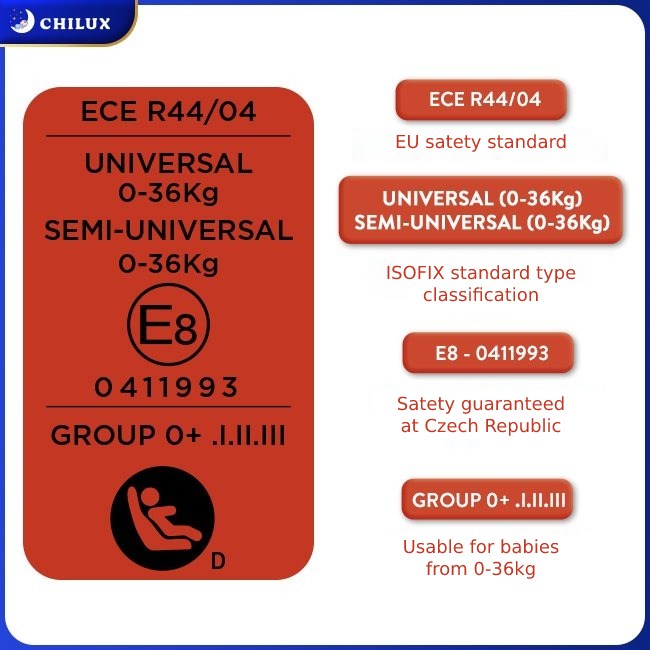
And this is also the latest version of Regulation No. 44 on safety standards for baby car seats issued by the European Economic Commission. Up to now, this version is still valid.
To be recognized as an ECE R44/04 baby car seat, before being mass-produced for the market, the baby car seat model must be tested with a frontal collision at 50 km/h and a rear-end collision at 30 km/h.
With the help of baby dummies and specialized measuring devices, experts can know how well a baby car seat is. If the safety standards are not met in the tests, the model must be redesigned and not allowed to be mass produced.
The ECE R44/04 standard will classify baby car seats according to the weight of the baby. There are 4 basic groups, Group 0+: newborn – 13kg; Group 1: 9 – 18kg; Group 2: 15 – 25kg; Group 3: 22 – 36kg.
This standard also clearly requires that baby car seats used for children in group 0+ must face back; Children from group 1 can face forward, but experts recommend a rearward facing position for babies in group 1.
ISOFIX and Seat Belt are two ways to install baby car seats on car seats according to ECE R44/04 standard. In particular, ISOFIX allows simple operation but ensures accuracy, and is recommended to become popular.
What is the European safety child car seat standard E8, E4?
ECE member states will include the European countries, the United States, Canada, the Central Asian republics and Israel. ECE R44/04 is issued by the European Economic Commission and recommended by member states but not mandatory. This means that member countries can fully apply the provisions of ECE R44/04 but can also have their own regulations.
And to distinguish baby car seats that have been tested and evaluated for safety standards in which member countries of the ECE, the E-mark label was born. E-mark labels are denoted very simply by a capital letter E, after this letter there will be a number. This number represents the country in which the audit was performed.
Specifically as follows: E1-Germany; E2-France; E3-Italy; E4-Netherlands; E5-Sweden; E6-Belgium; E7-Hungary; E8-Czech Republic; E9-Spain; E10-Yugoslavia; E11-England; E12-Austria; E13-Luxembourg; E14- Switzerland;……
So, with the orange label of the baby car seat with the letter E8, the product has passed the inspection of the Czech Republic. And E4 proves that the car seat has passed the tests in the Netherlands.
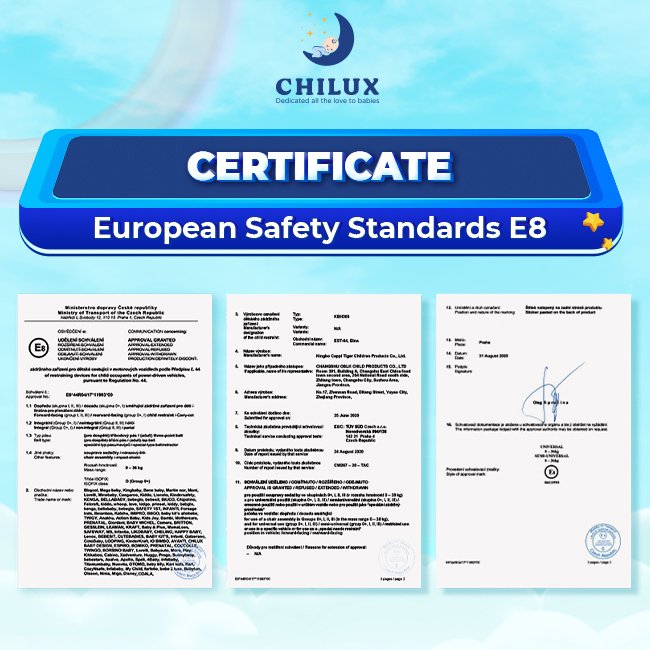
However, it should always be noted that a baby car seat with a capital E label indicates that it has been tested by an ECE country. But if a product is related to technical vehicles, motor vehicles and receives a lowercase e label, it proves to have passed the tests of a member state within the EU only (European Union).
Where should I check the European E8, E4 label for baby car seats?
Aim for users to easily check that the baby car seat that they are going to buy receives a safety certificate according to which European safety standard? Which country in the ECE conducts the test? How much is that child seat? Install ISOFIX or Seat Belt?…. Each baby car seat will have an orange label.
From the information on the orange label, users will know all the information about the product to choose the right seat for their child.
Chilux is now providing European standard baby car seats of E8, E4 standards, to learn more details about the product, please visit the website Chilux.sg or contact Hotline: +84388 922 442 for immediate support.
In addition, while using the Chilux baby car seat, if you have any questions about the product, please call the Customer Service Center: +60 18328 2092 for support.


Finding a job often involves more than just sending applications and waiting. It’s often a battle for attention from employers. This struggle is especially pronounced in highly competitive countries like the United States. People face a range of challenges that prevent them from finding stable income:
– High competition. A single job opening may attract dozens, if not hundreds, of candidates. These applicants’ rich portfolios and endorsements make it harder for fresh professionals to compete.
– Expectation of an established portfolio. It’s a catch-22: no experience means no job, but no job means no experience.
– Insufficient professional endorsements. References are crucial, yet many beginners or career changers simply don’t have them.
– Location-based restrictions. In rural or less populated areas, job availability may be scarce.
– Challenges faced by independent professionals. Even with the growth of online jobs, traditional preferences for in-person roles persist.
For beginners or career changers, these obstacles can seem insurmountable. This often forces candidates to accept underpaid roles or abandon their aspirations.
There Is a Way Out. You can bypass these barriers by leveraging online marketplaces for your services. These platforms help users find clients despite lacking a strong portfolio.
Why Is It So Hard to Find Work Nearby?
Searching for work close to home seems like the easiest solution for many. In reality, this method is often fraught with unanticipated challenges:
– Scarcity of vacancies. Small towns and city outskirts frequently lack sufficient openings, especially for highly specialized roles.
– Qualification gaps. Local opportunities often don’t match candidates’ professional abilities. As an example, IT experts might only see local openings for unrelated fields like retail or construction.
– Below-market salaries. Pay scales for nearby jobs often fail to match industry standards.
– Scheduling issues. Close-to-home jobs often come with rigid or impractical schedules.
The Central Idea. Modern technology has made being physically present unnecessary for many roles. Digital tools enable professionals to work for clients far beyond their immediate area. Moreover, this approach allows you to select clients who are willing to pay fair rates for your skills rather than just for convenient location.
Many who have embraced marketplaces highlight the greater flexibility and wider client base. An example from another platform shows how one professional doubled their revenue by moving away from local-only work.
How Do Marketplaces Solve the Earning Problem?
Marketplaces are a game-changer for professionals facing employment difficulties. These platforms make earning easy, even for those without portfolios or strong resumes.
– Wide access to clients. Clients from anywhere can now access your services.
– Minimal startup costs. To begin working on a marketplace, you don’t need to invest in an office, advertising, or expensive tools.
– Flexible scheduling. These platforms allow for a work-life balance tailored to individual preferences.
– Transaction protection mechanisms. Marketplaces’ transaction systems protect users from financial risks.
A Notable Case. Link to his story – [url=https://www.tumblr.com/employmenttoday]Find Leads[/url]. A user recounted how beginning with minor projects eventually built a sustainable career. With continuous improvement supported by feedback, they expanded their professional reach.
how can i get cheap zyvox without rx
Meds prescribing information. What side effects can this medication cause?
cost synthroid without rx
Some trends of medicine. Read now.
Sanbenefit.ru – это ваш проверенный интернет-магазин сантехнических решений, где вы найдете разнообразие товаров от ведущих брендов по доступным ценам. Мы предлагаем условия, которые вас приятно удивят, а наши профессиональные менеджеры помогут с подбором, ответив на любые вопросы по ваннам, унитазам, смесителям и другим сантехническим изделиям. На https://sanbenefit.ru/ удобная навигация с фильтрацией и сортировкой, а также регулярно пополняемый каталог, сэкономят ваше время и облегчат процесс поиска необходимых покупок
buy cipro online canada: ci pharm delivery – ciprofloxacin