
Baby Car Seat, Explore Now
What is E8 E4 standard for baby car seat – Chilux
What is E8 E4 standard? E8 is certified by the Czech Republic and when the baby car seat is tested and certified in the Netherlands, it will have the E4 label.
Car seats for children are stamped with an E-certified orange, proving that the product has passed safety tests conducted by a member country in the ECE stands for Economic Commission for Europe.
Above is some basic information, to be able to understand clearly what are the European safety car seat standards for children E8, E4? Then let’s find out more details with Chilux.
Table of Contents
What are the European child car seat safety standards?
The European child car seat safety standard is regulated and promulgated by the ECE. If car seat products pass the ECE tests, they can be sold and used in ECE member countries and registered countries that comply with ECE regulations.
Up to now, through research, testing, etc., there are two sets of European car seat safety standards issued, ECE R44 and ECE i-Size.
ECE R44 was approved on November 17, 1982, in Europe, after a series of child car seat safety tests. This regulation is in force in most European territories, as well as member states. To date, the ECE R44 standard has undergone four revisions to meet practical safety requirements.
Thus, the last two digits of the ECE regulation R44/04 that we still see on the orange baby car seat labels, indicate that the product has been approved under the fourth version of the regulation, entered into force in June 2005
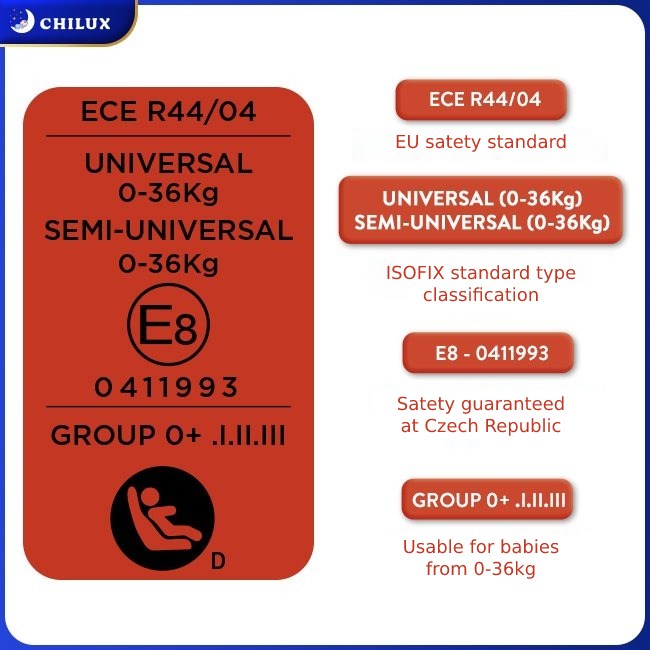
And this is also the latest version of Regulation No. 44 on safety standards for baby car seats issued by the European Economic Commission. Up to now, this version is still valid.
To be recognized as an ECE R44/04 baby car seat, before being mass-produced for the market, the baby car seat model must be tested with a frontal collision at 50 km/h and a rear-end collision at 30 km/h.
With the help of baby dummies and specialized measuring devices, experts can know how well a baby car seat is. If the safety standards are not met in the tests, the model must be redesigned and not allowed to be mass produced.
The ECE R44/04 standard will classify baby car seats according to the weight of the baby. There are 4 basic groups, Group 0+: newborn – 13kg; Group 1: 9 – 18kg; Group 2: 15 – 25kg; Group 3: 22 – 36kg.
This standard also clearly requires that baby car seats used for children in group 0+ must face back; Children from group 1 can face forward, but experts recommend a rearward facing position for babies in group 1.
ISOFIX and Seat Belt are two ways to install baby car seats on car seats according to ECE R44/04 standard. In particular, ISOFIX allows simple operation but ensures accuracy, and is recommended to become popular.
What is the European safety child car seat standard E8, E4?
ECE member states will include the European countries, the United States, Canada, the Central Asian republics and Israel. ECE R44/04 is issued by the European Economic Commission and recommended by member states but not mandatory. This means that member countries can fully apply the provisions of ECE R44/04 but can also have their own regulations.
And to distinguish baby car seats that have been tested and evaluated for safety standards in which member countries of the ECE, the E-mark label was born. E-mark labels are denoted very simply by a capital letter E, after this letter there will be a number. This number represents the country in which the audit was performed.
Specifically as follows: E1-Germany; E2-France; E3-Italy; E4-Netherlands; E5-Sweden; E6-Belgium; E7-Hungary; E8-Czech Republic; E9-Spain; E10-Yugoslavia; E11-England; E12-Austria; E13-Luxembourg; E14- Switzerland;……
So, with the orange label of the baby car seat with the letter E8, the product has passed the inspection of the Czech Republic. And E4 proves that the car seat has passed the tests in the Netherlands.
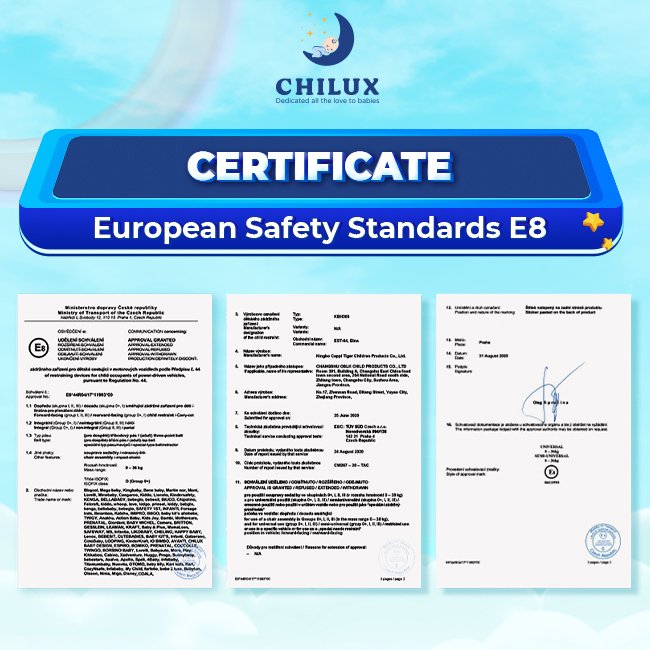
However, it should always be noted that a baby car seat with a capital E label indicates that it has been tested by an ECE country. But if a product is related to technical vehicles, motor vehicles and receives a lowercase e label, it proves to have passed the tests of a member state within the EU only (European Union).
Where should I check the European E8, E4 label for baby car seats?
Aim for users to easily check that the baby car seat that they are going to buy receives a safety certificate according to which European safety standard? Which country in the ECE conducts the test? How much is that child seat? Install ISOFIX or Seat Belt?…. Each baby car seat will have an orange label.
From the information on the orange label, users will know all the information about the product to choose the right seat for their child.
Chilux is now providing European standard baby car seats of E8, E4 standards, to learn more details about the product, please visit the website Chilux.sg or contact Hotline: +84388 922 442 for immediate support.
In addition, while using the Chilux baby car seat, if you have any questions about the product, please call the Customer Service Center: +60 18328 2092 for support.


If money is tight, buy your periactin withdrawal symptoms at any site, check out its composition too.
Meds information sheet. Long-Term Effects.
how can i get prevacid online
Everything information about drug. Get here.
Autism Spectrum Disorder (ASD) is a complex neurodevelopmental condition characterized by challenges in social interaction, communication, and repetitive behaviors. In recent years, there has been growing interest in exploring innovative treatment options, including the use of stem cells. This article provides an overview of the potential benefits and challenges associated with stem cell therapy in autism treatment.
Understanding Stem Cells
Stem cells are unique cells with the ability to develop into various cell types in the body. They have the potential to regenerate damaged tissues and promote healing, which is why researchers are investigating their use in various medical conditions, including neurological disorders. The primary types of stem cells used in research include:
– Embryonic Stem Cells: These are derived from early embryos and can develop into any cell type in the body.
– Adult Stem Cells: Found in various tissues, these cells can typically differentiate into a limited range of cell types.
– Induced Pluripotent Stem Cells (iPSCs): These are adult cells that have been genetically reprogrammed to an embryonic stem cell-like state.
The Rationale for Stem Cell Therapy in Autism
The use of stem cells in autism treatment is based on several theories regarding the underlying causes of the disorder, including [url=https://www.autism-mmc.com/publications/prohibitions/]https://www.autism-mmc.com/publications/prohibitions/[/url]
– Neuroinflammation: Some studies suggest that inflammation in the brain may contribute to autism symptoms. Stem cells might help reduce inflammation and promote healing.
– Neuronal Connectivity: Stem cells could potentially aid in creating new neuronal connections, enhancing communication between brain regions.
Current Research and Findings
Research on stem cell therapy for autism is still in its early stages. Some studies have shown promising results, indicating improvements in behavioral and cognitive functions in children with ASD after stem cell treatment. For example, certain types of stem cells, such as umbilical cord blood stem cells, have been associated with positive outcomes.
However, it is important to note that most studies are small, and more significant research is needed to validate these findings. Clinical trials are ongoing to assess the safety and efficacy of stem cell treatments for autism.
Challenges and Considerations
While stem cell therapy offers exciting possibilities, several challenges remain:
– Safety Concerns: There are risks associated with stem cell procedures, including infections, immune reactions, and tumor formation.
– Regulatory Issues: The use of stem cells in clinical practice is subject to strict regulations, and not all therapies are approved for use.
– Ethical Considerations: The extraction of stem cells, particularly from embryos, raises ethical questions that must be addressed.
Conclusion
The exploration of stem cell therapy for autism is an evolving field with potential benefits. While early research indicates promise, further studies are crucial to establish safety, efficacy, and practical applications. Families considering this treatment should consult with healthcare professionals and stay informed about ongoing research and advancements in the field. As our understanding of autism and stem cell biology grows, new therapeutic options may emerge, offering hope for individuals with ASD.
Medicine information for patients. Cautions.
can you buy generic linezolid tablets
Best trends of medicines. Read here.
cleocin side effects vaginal cream cleocin adverse reactions cleocin online italian
world pharmacy cleocin cleocin pediatric liquid Cleocin suppository dosage children
buying cheap cleocin for sale
can cleocin cause a rash where to buy cleocin online can you buy generic cleocin
pfizer cleocin t patient information cleocin dosage forms of benadryl can Cleocin make you aroused