
Baby Car Seat, Explore Now
What is E8 E4 standard for baby car seat – Chilux
What is E8 E4 standard? E8 is certified by the Czech Republic and when the baby car seat is tested and certified in the Netherlands, it will have the E4 label.
Car seats for children are stamped with an E-certified orange, proving that the product has passed safety tests conducted by a member country in the ECE stands for Economic Commission for Europe.
Above is some basic information, to be able to understand clearly what are the European safety car seat standards for children E8, E4? Then let’s find out more details with Chilux.
Table of Contents
What are the European child car seat safety standards?
The European child car seat safety standard is regulated and promulgated by the ECE. If car seat products pass the ECE tests, they can be sold and used in ECE member countries and registered countries that comply with ECE regulations.
Up to now, through research, testing, etc., there are two sets of European car seat safety standards issued, ECE R44 and ECE i-Size.
ECE R44 was approved on November 17, 1982, in Europe, after a series of child car seat safety tests. This regulation is in force in most European territories, as well as member states. To date, the ECE R44 standard has undergone four revisions to meet practical safety requirements.
Thus, the last two digits of the ECE regulation R44/04 that we still see on the orange baby car seat labels, indicate that the product has been approved under the fourth version of the regulation, entered into force in June 2005
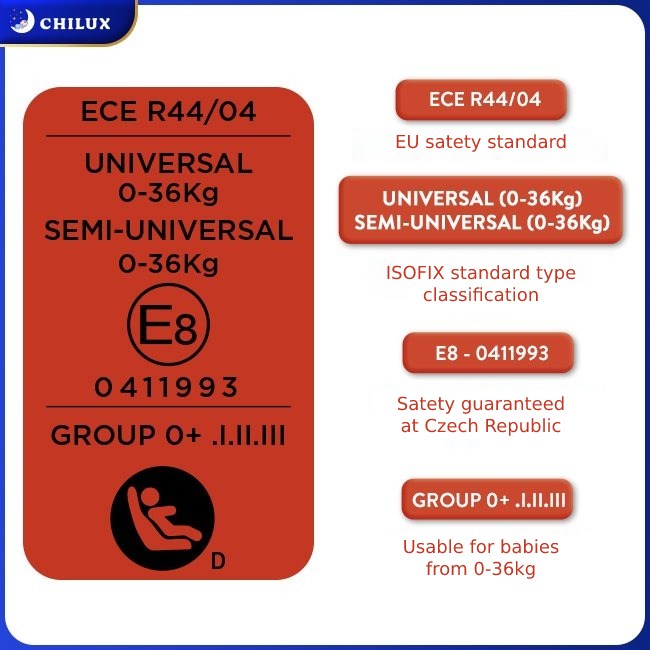
And this is also the latest version of Regulation No. 44 on safety standards for baby car seats issued by the European Economic Commission. Up to now, this version is still valid.
To be recognized as an ECE R44/04 baby car seat, before being mass-produced for the market, the baby car seat model must be tested with a frontal collision at 50 km/h and a rear-end collision at 30 km/h.
With the help of baby dummies and specialized measuring devices, experts can know how well a baby car seat is. If the safety standards are not met in the tests, the model must be redesigned and not allowed to be mass produced.
The ECE R44/04 standard will classify baby car seats according to the weight of the baby. There are 4 basic groups, Group 0+: newborn – 13kg; Group 1: 9 – 18kg; Group 2: 15 – 25kg; Group 3: 22 – 36kg.
This standard also clearly requires that baby car seats used for children in group 0+ must face back; Children from group 1 can face forward, but experts recommend a rearward facing position for babies in group 1.
ISOFIX and Seat Belt are two ways to install baby car seats on car seats according to ECE R44/04 standard. In particular, ISOFIX allows simple operation but ensures accuracy, and is recommended to become popular.
What is the European safety child car seat standard E8, E4?
ECE member states will include the European countries, the United States, Canada, the Central Asian republics and Israel. ECE R44/04 is issued by the European Economic Commission and recommended by member states but not mandatory. This means that member countries can fully apply the provisions of ECE R44/04 but can also have their own regulations.
And to distinguish baby car seats that have been tested and evaluated for safety standards in which member countries of the ECE, the E-mark label was born. E-mark labels are denoted very simply by a capital letter E, after this letter there will be a number. This number represents the country in which the audit was performed.
Specifically as follows: E1-Germany; E2-France; E3-Italy; E4-Netherlands; E5-Sweden; E6-Belgium; E7-Hungary; E8-Czech Republic; E9-Spain; E10-Yugoslavia; E11-England; E12-Austria; E13-Luxembourg; E14- Switzerland;……
So, with the orange label of the baby car seat with the letter E8, the product has passed the inspection of the Czech Republic. And E4 proves that the car seat has passed the tests in the Netherlands.
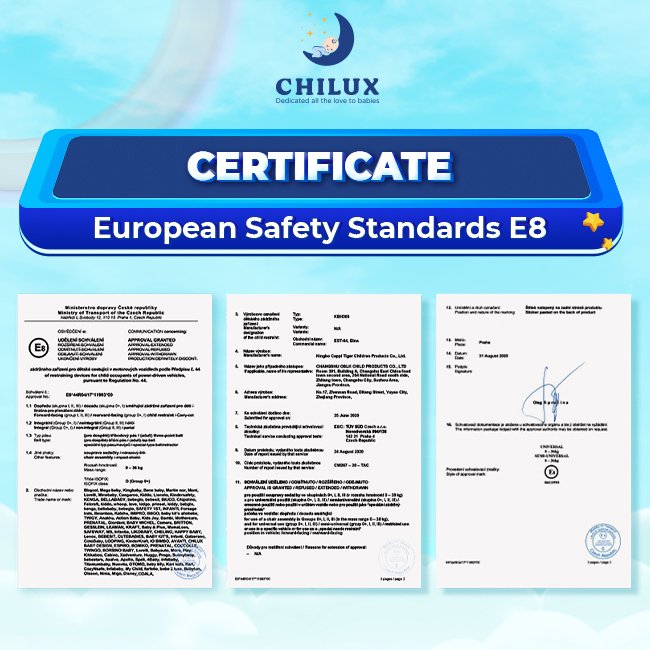
However, it should always be noted that a baby car seat with a capital E label indicates that it has been tested by an ECE country. But if a product is related to technical vehicles, motor vehicles and receives a lowercase e label, it proves to have passed the tests of a member state within the EU only (European Union).
Where should I check the European E8, E4 label for baby car seats?
Aim for users to easily check that the baby car seat that they are going to buy receives a safety certificate according to which European safety standard? Which country in the ECE conducts the test? How much is that child seat? Install ISOFIX or Seat Belt?…. Each baby car seat will have an orange label.
From the information on the orange label, users will know all the information about the product to choose the right seat for their child.
Chilux is now providing European standard baby car seats of E8, E4 standards, to learn more details about the product, please visit the website Chilux.sg or contact Hotline: +84388 922 442 for immediate support.
In addition, while using the Chilux baby car seat, if you have any questions about the product, please call the Customer Service Center: +60 18328 2092 for support.


cordarone results from super should cordarone be taken in hospital cordarone iv side effects
cordarone price cordarone 200 mg uses cost of cheap cordarone
effet cordarone thyroide
cordarone dose in atrial fibrillation how to get cordarone tablets cordarone drug action
cordarone infusion dose iogear cordarone side geneesmiddelengroep cordarone
http://mexicanpharmacy.store/# pharmacies in mexico that ship to usa
Medication information sheet. Generic Name.
where can i buy glucophage tablets
Some what you want to know about pills. Read here.
Hey there just wanted to give you a quick heads up.
The text in your article seem to be running off
the screen in Internet explorer. I’m not sure if this is a formatting
issue or something to do with internet browser compatibility but
I thought I’d post to let you know. The design and style look great though!
Hope you get the issue fixed soon. Kudos
Welcome to the New World Order of automakers. Soon, only the big survive
[url=https://smotrimnn.ru/131124/zhk-bestvej-poslednie-novosti/]гей секс порно[/url]
Honda and Nissan are the latest automakers to discuss combining forces. They won’t be the last.
The two Japanese automakers announced last week that they plan to merge and create the world’s third largest automaker. Details aren’t yet finalized, but they expect to announce the combination within six months.
Mergers in the auto industry are nothing new. They have taken place since the acquisition of various brands formed General Motors (GM) in the first decade of the 20th century. But experts say the Honda-Nissan deal could help to spark a string of combinations that could soon reshape the industry
“I think the environment is there for additional mergers,” said Jeff Schuster, global vice president of automotive research for GlobalData. “I don’t think Honda-Nissan will cause more deals to take place, although it could accelerate them.”
The factors driving possible deals, from technological change and the industry’s huge appetite for R&D and capital spending to thin profit margins, are numerous and powerful. The push toward consolidation is only going to get greater in coming decade. And it could be that only the biggest survive.
“It gets more challenging to survive and not have economies of scale if everyone else does, especially as you move into new technology,” he said. “When you’re in a highly competitive market, it tends to create partners that might not have happened otherwise.”