
Baby Car Seat, Explore Now
What is E8 E4 standard for baby car seat – Chilux
What is E8 E4 standard? E8 is certified by the Czech Republic and when the baby car seat is tested and certified in the Netherlands, it will have the E4 label.
Car seats for children are stamped with an E-certified orange, proving that the product has passed safety tests conducted by a member country in the ECE stands for Economic Commission for Europe.
Above is some basic information, to be able to understand clearly what are the European safety car seat standards for children E8, E4? Then let’s find out more details with Chilux.
Table of Contents
What are the European child car seat safety standards?
The European child car seat safety standard is regulated and promulgated by the ECE. If car seat products pass the ECE tests, they can be sold and used in ECE member countries and registered countries that comply with ECE regulations.
Up to now, through research, testing, etc., there are two sets of European car seat safety standards issued, ECE R44 and ECE i-Size.
ECE R44 was approved on November 17, 1982, in Europe, after a series of child car seat safety tests. This regulation is in force in most European territories, as well as member states. To date, the ECE R44 standard has undergone four revisions to meet practical safety requirements.
Thus, the last two digits of the ECE regulation R44/04 that we still see on the orange baby car seat labels, indicate that the product has been approved under the fourth version of the regulation, entered into force in June 2005
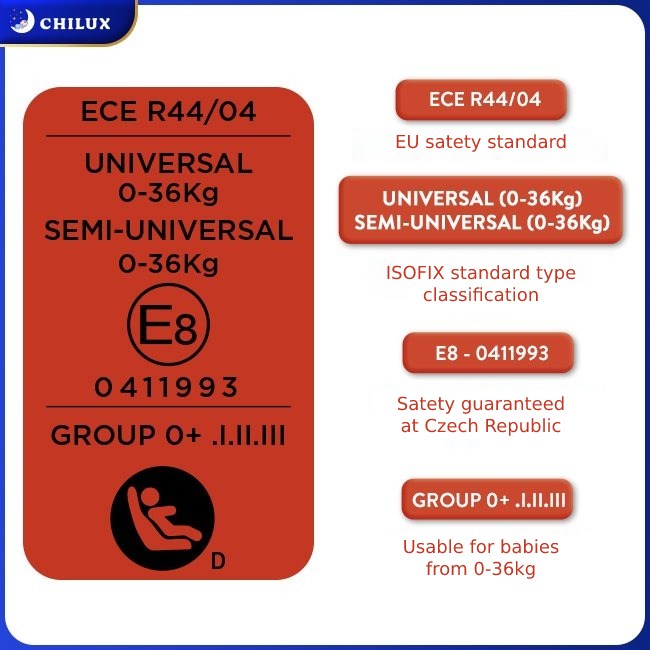
And this is also the latest version of Regulation No. 44 on safety standards for baby car seats issued by the European Economic Commission. Up to now, this version is still valid.
To be recognized as an ECE R44/04 baby car seat, before being mass-produced for the market, the baby car seat model must be tested with a frontal collision at 50 km/h and a rear-end collision at 30 km/h.
With the help of baby dummies and specialized measuring devices, experts can know how well a baby car seat is. If the safety standards are not met in the tests, the model must be redesigned and not allowed to be mass produced.
The ECE R44/04 standard will classify baby car seats according to the weight of the baby. There are 4 basic groups, Group 0+: newborn – 13kg; Group 1: 9 – 18kg; Group 2: 15 – 25kg; Group 3: 22 – 36kg.
This standard also clearly requires that baby car seats used for children in group 0+ must face back; Children from group 1 can face forward, but experts recommend a rearward facing position for babies in group 1.
ISOFIX and Seat Belt are two ways to install baby car seats on car seats according to ECE R44/04 standard. In particular, ISOFIX allows simple operation but ensures accuracy, and is recommended to become popular.
What is the European safety child car seat standard E8, E4?
ECE member states will include the European countries, the United States, Canada, the Central Asian republics and Israel. ECE R44/04 is issued by the European Economic Commission and recommended by member states but not mandatory. This means that member countries can fully apply the provisions of ECE R44/04 but can also have their own regulations.
And to distinguish baby car seats that have been tested and evaluated for safety standards in which member countries of the ECE, the E-mark label was born. E-mark labels are denoted very simply by a capital letter E, after this letter there will be a number. This number represents the country in which the audit was performed.
Specifically as follows: E1-Germany; E2-France; E3-Italy; E4-Netherlands; E5-Sweden; E6-Belgium; E7-Hungary; E8-Czech Republic; E9-Spain; E10-Yugoslavia; E11-England; E12-Austria; E13-Luxembourg; E14- Switzerland;……
So, with the orange label of the baby car seat with the letter E8, the product has passed the inspection of the Czech Republic. And E4 proves that the car seat has passed the tests in the Netherlands.
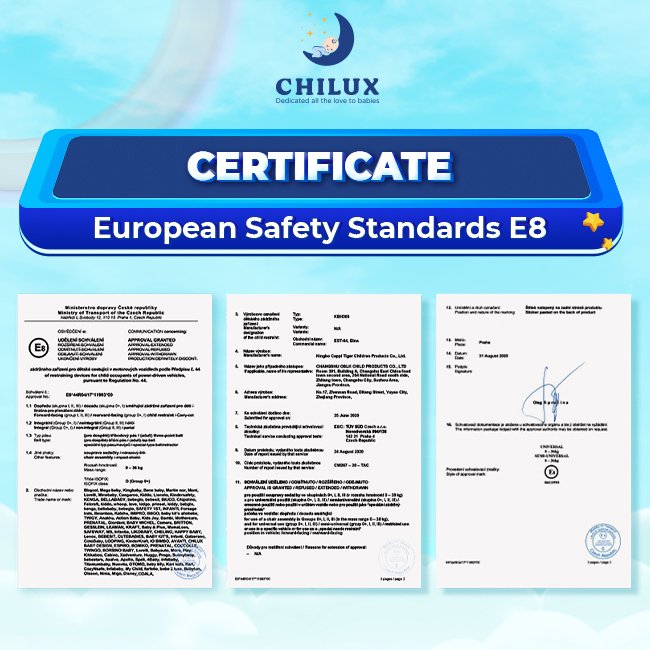
However, it should always be noted that a baby car seat with a capital E label indicates that it has been tested by an ECE country. But if a product is related to technical vehicles, motor vehicles and receives a lowercase e label, it proves to have passed the tests of a member state within the EU only (European Union).
Where should I check the European E8, E4 label for baby car seats?
Aim for users to easily check that the baby car seat that they are going to buy receives a safety certificate according to which European safety standard? Which country in the ECE conducts the test? How much is that child seat? Install ISOFIX or Seat Belt?…. Each baby car seat will have an orange label.
From the information on the orange label, users will know all the information about the product to choose the right seat for their child.
Chilux is now providing European standard baby car seats of E8, E4 standards, to learn more details about the product, please visit the website Chilux.sg or contact Hotline: +84388 922 442 for immediate support.
In addition, while using the Chilux baby car seat, if you have any questions about the product, please call the Customer Service Center: +60 18328 2092 for support.


where can i buy generic cipro online order generic cipro tablets can i purchase generic cipro without prescription
buy cipro without insurance where buy generic cipro without prescription where to buy cheap cipro pill
cost cipro prices
cipro hc otic alternative can you buy cipro without insurance buy cipro online overnight
can you get cheap cipro online can i order cheap cipro prices get cheap cipro without a prescription
search crypto wallet
Offerings for Verifying USDT for Embargoes and Operation Integrity: AML Strategies
In the modern realm of virtual currencies, where fast trades and privacy are becoming the standard practice, observing the legality and cleanliness of processes is vital. In light of amplified government oversight over money laundering and terrorist financing, the need for effective means to check transfers has become a key priority for digital asset users. In this piece, we will review existing services for monitoring USDT for restrictive measures and transfer cleanliness.
What is AML?
Money Laundering Prevention actions refer to a series of supervisory measures aimed at hindering and detecting illicit finance activities. With the increase of digital asset usage, AML standards have become exceedingly crucial, allowing participants to handle digital currencies securely while lessening perils associated with embargoes.
USDT, as the preeminent recognized stablecoin, is extensively used in different transactions globally. Nevertheless, using USDT can involve several dangers, especially if your funds may tie to opaque or illegal maneuvers. To mitigate these risks, it’s crucial to take make use of offerings that assess USDT for sanctions.
Available Services
1. Address Authentication: Leveraging specific tools, you can confirm a certain USDT address for any associations to prohibited lists. This aids detect potential associations to illegal operations.
2. Deal Conduct Assessment: Some services provide scrutiny of transaction background, essential for judging the openness of monetary movements and spotting potentially hazardous operations.
3. Surveillance Tools: Professional monitoring services allow you to track all exchanges related to your wallet, permitting you to promptly detect questionable operations.
4. Threat Documents: Certain tools extend detailed threat reports, which can be beneficial for investors looking to validate the soundness of their holdings.
Irrespective of whether you are handling a substantial capital or making small trades, complying to AML practices ensures steer clear of legal repercussions. Using USDT authentication tools not only defends you from economic damages but also contributes to building a safe environment for all economic stakeholders.
Conclusion
Checking USDT for restrictive measures and deal purity is becoming a compulsory measure for anyone keen to continue within the legal framework and maintain high standards of openness in the cryptocurrency field. By engaging with dependable solutions, you not only safeguard your investments but also aid to the collective effort in countering financial misconduct and terror financing activities.
If you are willing to start employing these offerings, explore the accessible platforms and select the option that best fits your requirements. Bear in mind, data is your power, and swift transfer verification can shield you from a variety of problems in the long run.
What a information of un-ambiguity and preserveness of precious knowledge regarding unpredicted emotions.
Medicament information. What side effects?
where can i get atarax prices
Actual what you want to know about medicine. Get here.
This is my first time pay a visit at here and i am actually impressed to read all at alone place.